
Can you still win $5,000 a week for life? For decades, Publishers Clearing House (PCH) was famous for its Prize Patrol, oversized checks and the dream prize of $5,000 a week for life, or even “forever”, with payments continuing to a person the winner chose. In 2025 that story changed dramatically. Here’s what happened and what it means if you still enter sweepstakes.
Table of Contents
$5,000 a week for life: the short version
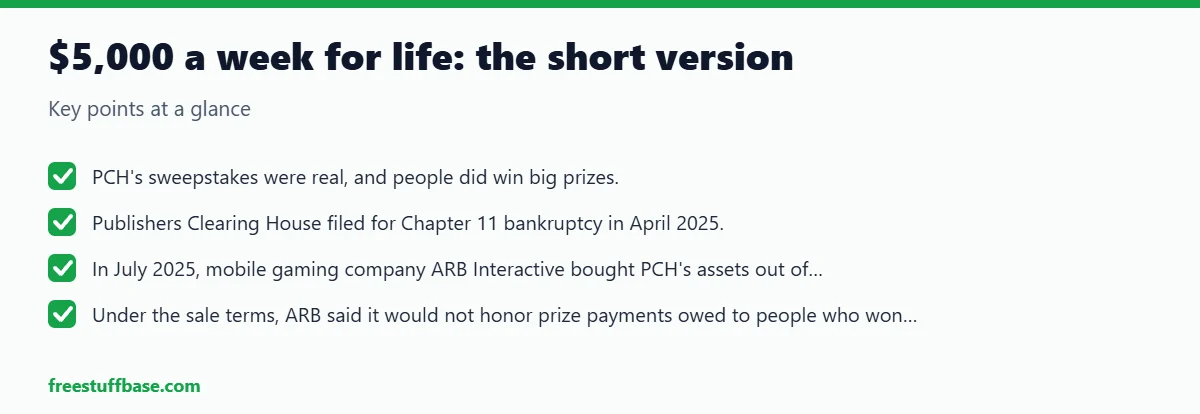
- PCH’s sweepstakes were real, and people did win big prizes.
- Publishers Clearing House filed for Chapter 11 bankruptcy in April 2025.
- In July 2025, mobile gaming company ARB Interactive bought PCH’s assets out of bankruptcy for about $7.1 million and launched the brand as “PCH Digital”.
- Under the sale terms, ARB said it would not honor prize payments owed to people who won before July 15, 2025. Many “forever” winners stopped receiving their weekly checks, and they became unsecured creditors in the bankruptcy case.
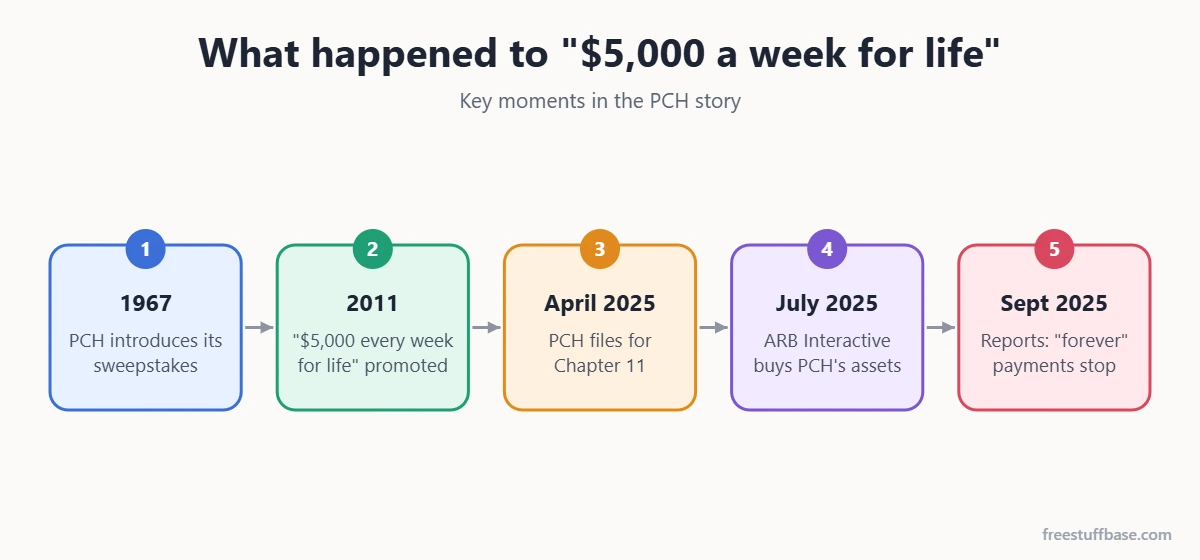
Timeline: what happened to PCH
Publishers Clearing House introduced its sweepstakes in 1967 and promoted the “$5,000 every week for life” prize from 2011. In April 2025 the company filed for Chapter 11 bankruptcy, and in July 2025 mobile gaming company ARB Interactive bought its assets. By September 2025, past winners were telling reporters their “forever” payments had stopped, as CNN reported via ABC7. The new owner said it plans a separate payment structure so that future prizes are honored.
How did a “for life” prize stop paying?
Lifetime prizes are only as secure as the company’s plan for funding them. According to reporting by ConsumerAffairs, a former PCH executive said the company once protected prizes with prepaid annuities but stopped doing that after 2003. When the company went bankrupt, the remaining lifetime payments became debts competing with other creditors. A federal bankruptcy court decides how the remaining assets are divided.
Were PCH sweepstakes ever a scam?
The prizes were real, but PCH faced repeated criticism over its marketing. In 2023 PCH agreed to pay $18.5 million under a settlement with the FTC and to change practices that the agency said misled consumers into thinking a purchase was needed to enter or would improve their chances of winning. The FTC began distributing refunds to affected customers.
The odds for the top prize were always tiny. PCH’s own rules for its biggest “forever” prizes put the odds at roughly 1 in several billion.
How much is $5,000 a week for life really worth?
On paper, $5,000 a week for life adds up to $260,000 a year before taxes. Prizes are taxable income in the U.S., so the amount a winner actually keeps is lower, and the IRS explains how prizes are taxed in Publication 525. The bigger issue is time: a lifetime prize is a promise that the sponsor will keep paying for decades. If the sponsor’s finances change, so does the value of that promise.
Should you still enter?
That’s your decision. If you do:
- Read the current official rules on the official PCH site, including who the sponsor is, how prizes are paid and whether there’s a lump-sum option.
- Remember: no purchase is necessary. It’s illegal for a sweepstakes to require a purchase or payment to enter, or to claim that buying something increases your odds.
- Prefer a lump sum if a future prize offers the choice. Long-term installment prizes depend on the sponsor staying solvent.
If you were a past winner
- Keep every document about your prize: notifications, contracts, tax forms and payment records.
- Follow the bankruptcy case, since past winners were treated as unsecured creditors.
- Talk to an attorney about your claim and a financial adviser about your budget.
- Be wary of anyone who contacts you offering to “recover” your prize for a fee.
PCH by the numbers
| Fact | Detail |
|---|---|
| Founded | 1953, by the Mertz family on Long Island, selling magazine subscriptions by mail |
| Revenue | Fell from about $854 million in 2017 to about $182 million in 2023 |
| Bankruptcy filing | Chapter 11 in April 2025 |
| Debts vs. assets at filing | Liabilities of $50–$100 million (including promised prizes) vs. assets of $1–$10 million |
| Winners as creditors | 10 prize winners were among the 20 largest unsecured creditors |
| New owner | ARB Interactive, a mobile gaming company, bought the remaining assets in July 2025 |
| Prizes honored | Only prizes awarded after July 15, 2025 |
What “unsecured creditor” means for $5,000 a week for life winners
In a bankruptcy, people owed money are paid in a set order. Secured lenders, who hold collateral, usually come first. Unsecured creditors, such as suppliers and, in this case, prize winners, share whatever is left. With PCH’s assets worth only a small fraction of its debts, past winners had little chance of getting more than a sliver of what they were promised. That’s why winners who had been receiving checks for years, including people who won the $5,000 a week for life prize back in 2001 and 2012, suddenly stopped being paid.
Who runs Publishers Clearing House now?
ARB Interactive now owns the Publishers Clearing House brand. It has said it is not responsible for prize obligations from before its acquisition, but it has committed to honoring prizes awarded after July 15, 2025, and to rebuilding trust in the brand. If you enter a PCH-branded game or sweepstakes today, read the official rules carefully: check who the sponsor is, how prizes are paid and whether any “for life” prize is backed by an annuity or insurance policy.
How to protect yourself if you ever win a “for life” prize
- Ask how the prize is funded. Prizes backed by an annuity from an insurance company are safer than payments made from a company’s own budget.
- Compare the lump-sum option. A smaller amount paid now can’t be taken away by a future bankruptcy.
- Don’t rely on one income stream. Keep working or investing as if the payments could stop.
- Talk to a tax professional and a fee-only financial planner before deciding.
For more on safer contests, read which sweepstakes are legitimate and how to win sweepstakes.
PCH scams to watch for
PCH’s fame makes it a favorite target for impostors. Scammers call, text or write saying you’ve won and must pay “taxes”, “fees” or “shipping” first, sometimes using the names of real employees.
Real sweepstakes never ask you to pay to collect a prize. If someone asks you to send money, buy gift cards, wire funds or share your bank details to claim a PCH prize, it’s a scam. Report it at ReportFraud.ftc.gov. The FTC’s guide to fake prize and sweepstakes scams explains the warning signs.
Why “for life” prizes are rare
Most sweepstakes sponsors prefer prizes with a fixed cost, such as cash, cars or trips, because they know exactly what they will pay. A lifetime prize is open-ended: the sponsor has to plan for a winner who might live for 50 years or more. Sponsors usually manage this with insurance or annuities. Reporting on the PCH case suggested the company had stopped insuring these prizes years earlier, which left winners exposed when the business failed.
If you ever win a big prize
- Take time before accepting: read the prize terms and ask how it will be paid.
- Choose a lump sum if it’s offered and you’re worried about the sponsor’s future.
- Speak to a tax professional and a financial adviser before spending anything.
- Keep copies of every document and payment.
- Expect scammers to target you once your win is public, and never pay anyone to “release” a prize.
The lesson for every sweepstakes fan
- Big prizes paid over many years carry risk.
- The sponsor’s reputation and financial health matter.
- Official rules tell you exactly how a prize will be paid. Read them before you dream about the money.
Learn how to spot a real giveaway in our guide to which sweepstakes are legitimate.
What $5,000 a week for life is worth in today’s money
Competing articles quote the headline figure, but a prize paid over decades is worth less than its total today, because money received later buys less and cannot be invested now. Here is a simple present-value look at $5,000 a week for life, which works out to $260,000 a year before taxes.
| Years paid | Total paid | Value today at 4% a year | Value today at 6% a year |
|---|---|---|---|
| 20 years | $5.2 million | about $3.5 million | about $3.0 million |
| 30 years | $7.8 million | about $4.5 million | about $3.6 million |
These figures are rough illustrations, not financial advice. They show why some winners prefer a lump sum when one is offered, and why the security of the payer matters so much for a lifetime prize.
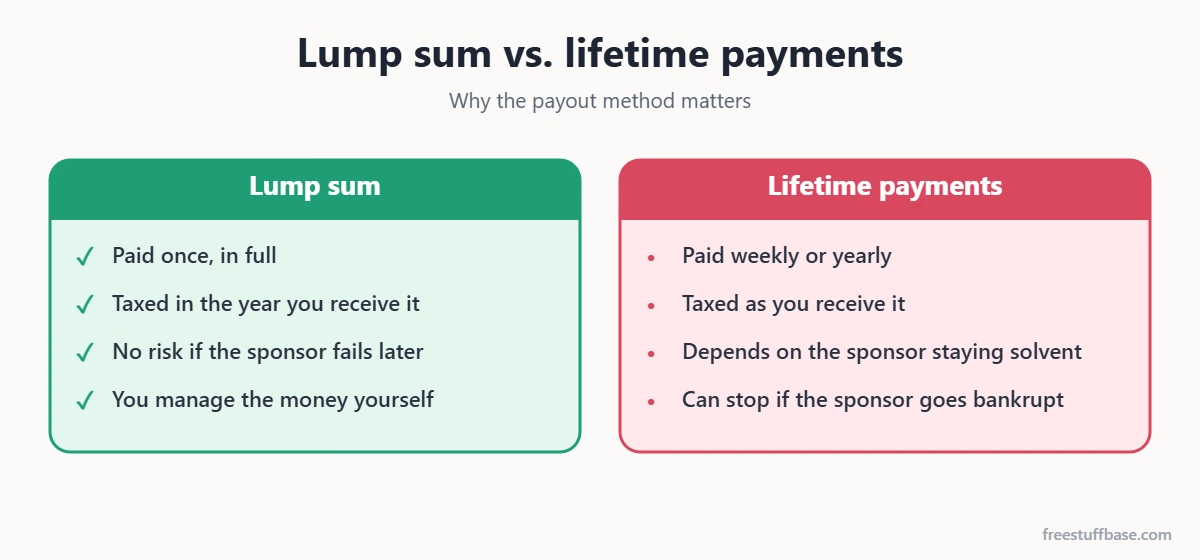
Lump sum vs lifetime payments
| Option | Pros | Cons |
|---|---|---|
| Lifetime payments | Steady income, built-in budgeting, protection against spending it all at once | Depends on the payer staying able to pay; worth less in today’s money |
| Lump sum (if offered) | Money in hand now, can be invested or used to pay off debt | Usually much smaller than the headline total; a big tax bill in one year |
Official rules decide whether a lump sum is available. For $5,000 a week for life style prizes, always read how payments are funded and what happens if the sponsor’s finances change.
Taxes on $5,000 a week for life
In the U.S., sweepstakes prizes are generally treated as taxable income. With lifetime payments, winners typically pay income tax each year on the amount received that year, rather than on the full prize at once. State taxes may also apply. A tax professional can explain how withholding, estimated payments and your other income affect what you keep from $5,000 a week for life.
A checklist for judging any lifetime prize
- Who is responsible for paying, and is the prize backed by an annuity or insurance company?
- Do the official rules explain what happens if the sponsor is sold, restructured or goes out of business?
- Is there a lump sum option, and how is it calculated?
- Can payments pass to a beneficiary, or do they stop when the winner dies?
- Does the sponsor ever ask for a fee to receive a prize? If yes, it is a scam.
These questions apply to $5,000 a week for life and to any other “for life” prize you might see advertised.
Spotting fake $5,000 a week for life messages
- Real sponsors do not ask winners to pay taxes, fees or insurance upfront to receive a prize.
- Unexpected calls, texts or social media messages claiming you won $5,000 a week for life are a classic scam setup.
- Look up the sponsor’s official contact details yourself rather than using numbers in the message.
- Report prize scams to the FTC at ReportFraud.ftc.gov.
FAQ
Can I still win $5,000 a week for life from PCH?
Check the current promotions and official rules on PCH’s official site. Prize offers under the new owner may differ from the classic PCH prizes.
Will past “forever” winners ever be paid?
That depends on the bankruptcy process. Past winners were treated as unsecured creditors, who are generally last in line.
Is PCH the same company as before?
The brand is now owned by ARB Interactive, which operates it as PCH Digital.
Were the PCH winners real?
Yes. Reporting by Marketplace and others confirms the winners shown in PCH ads were real people.
Is PCH still running sweepstakes?
The brand continues under its new owner, with promotions that may differ from the old ones. Always read the current official rules on the official PCH site before entering.
How do I know a PCH message is fake?
Real sweepstakes never ask you to pay fees, taxes or shipping to claim a prize, and they don’t ask for gift cards or wire transfers. If a call, text or letter does, it’s a scam. Hang up, don’t reply and report it to the FTC.
Final thoughts
The $5,000 a week for life prize was real, but the 2025 PCH bankruptcy showed that lifetime prizes are only as safe as the company paying them. If you enter sweepstakes, read the official rules, prefer a lump sum when you can choose, and never pay anyone to claim a prize. For safer sweepstaking, read which sweepstakes are legitimate, how to win sweepstakes and do sweepstakes really work.

Md. Emam Hasan is the founder of Freestuffbase and a digital marketer and SEO specialist based in Dhaka, Bangladesh. He researches free samples, gift card policies and sweepstakes rules from official sources, and writes practical guides to help readers save money and avoid scams. More at emamit.com.