
Do sweepstakes really work? It’s fair to wonder whether anyone actually wins those giveaways on cereal boxes, websites and social media. The honest answer: yes, real sweepstakes do pay out real prizes, but the odds for any single entry are usually low, and it pays to understand how they work before you spend time on them.
Table of Contents
How sweepstakes work
A sweepstakes is a promotion where winners are chosen by chance. Brands run them to build awareness, collect email subscribers and encourage people to try products. In the U.S., sweepstakes must offer a free way to enter, and buying something can’t increase your odds. That’s what separates a sweepstakes from a lottery, which requires paying for a ticket.
Do sweepstakes really work? Do people really win?
Yes. Prizes are awarded every day, from small gift cards to cars and trips. Brands are legally required to award the prizes described in their official rules, and many publish winners lists you can request.
But remember who is entering: popular national sweepstakes can attract millions of entries. A giveaway with one grand prize and huge publicity is a long shot; a local or niche giveaway with fewer entrants and many small prizes is a much better bet.
What affects your odds
To understand whether sweepstakes really work for you, it helps to know what moves the odds:
- Number of entrants: small, local and short-duration promotions usually have far fewer entries.
- Number of prizes: a promotion with 1,000 small prizes gives you more chances than one with a single big prize.
- Entry frequency: daily-entry sweepstakes reward people who enter consistently.
- Entry method: some sweepstakes award extra entries for mail-in or alternate entries; the rules say how.
The official rules usually state the odds or explain how they’re calculated.
The downsides to know about
Even if sweepstakes really work for you, there are a few downsides:
- Marketing emails: entering usually means joining a mailing list. Use a separate email address.
- Taxes: prizes count as income. Big prizes can mean a large tax bill, and sponsors typically report larger prizes to the IRS.
- Prize terms: some prizes come with conditions, such as travel dates, or can’t be swapped for cash.
- Long-term payments carry risk: prizes paid over many years depend on the sponsor staying solvent. The 2025 Publishers Clearing House bankruptcy left many “forever” prize winners without their weekly checks. Read more in our PCH $5,000 a week update.
- Scams: fake sweepstakes far outnumber the real ones in some places, especially in texts and social DMs.
Is it worth your time?
So, do sweepstakes really work as a hobby? Sweepstakes can be a fun, free hobby if you:
- Enter only legitimate promotions with official rules
- Set a time limit, like 15 minutes a day
- Focus on giveaways with more prizes and fewer entrants
- Never pay to enter or to claim a prize
Sweepstakes vs. contests vs. lotteries
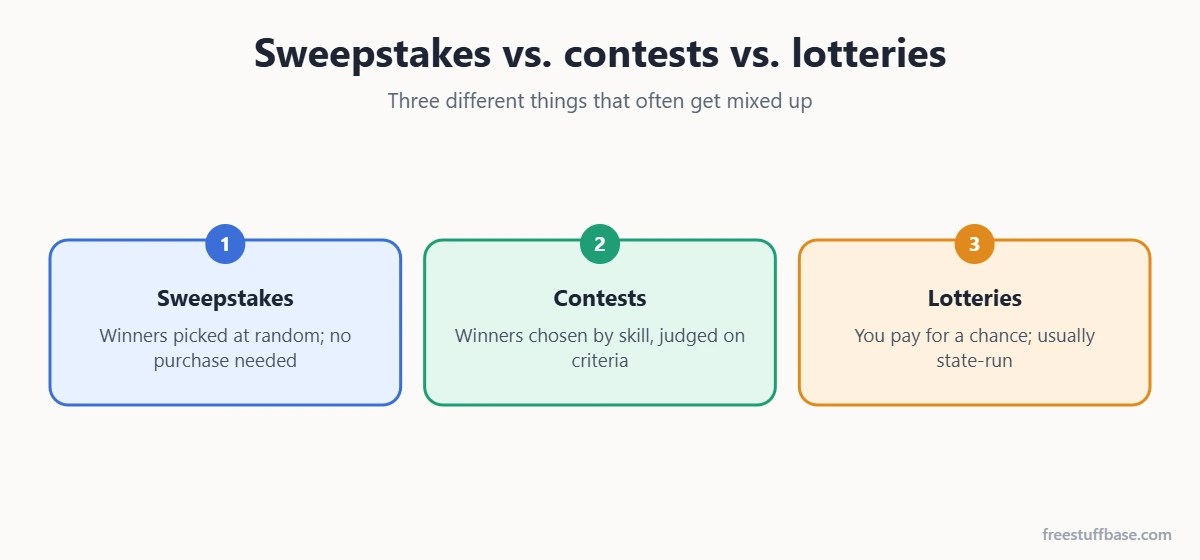
These three words get mixed up all the time, but they mean different things, and the difference matters for your odds:
- Sweepstakes: winners are picked at random. You can’t improve your chances except by entering as often as the rules allow. In the U.S., a sweepstakes must offer a free way to enter, which is why you see “no purchase necessary” in the rules.
- Contests: winners are chosen by skill. A judge or a panel picks the best photo, recipe, essay or video. Your effort directly affects your chances.
- Lotteries: you pay for a chance to win a prize picked at random. Lotteries are run by states, and a private company can’t legally require a purchase for a random-draw prize.
If a “sweepstakes” asks you to pay to enter or to pay to collect a prize, it’s either an illegal lottery or a scam.
A realistic look at the numbers
Do sweepstakes really work when you look at the numbers? The odds for any single sweepstakes depend on how many people enter, and big national giveaways can attract hundreds of thousands or even millions of entries. That’s why most regular sweepers spread their entries across many smaller giveaways. Local promotions, giveaways from small brands, and sweepstakes with short entry periods or entry methods that take a little effort usually attract far fewer entries. A sweepstakes with 500 entrants and ten prizes gives you much better odds than a national grand prize drawing.
For most regular entrants, the honest answer to “do sweepstakes really work” is yes, slowly. Many people who sweep regularly treat it as a hobby. They spend a set amount of time each day entering, and they’re happy with a few small prizes a year, such as gift cards, kitchen gadgets or concert tickets. Occasionally a bigger prize comes along too. If you go in with that mindset, sweepstakes can be fun. If you go in expecting to replace an income, you’ll be disappointed.
What winning actually looks like
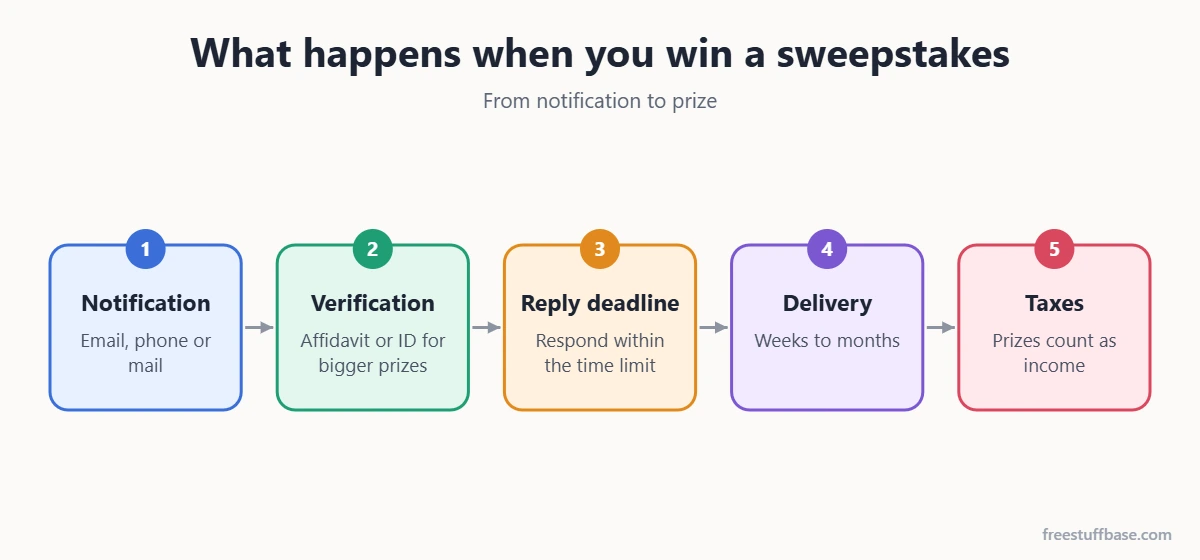
- Notification: winners are usually contacted by email, phone or a direct message from the sponsor’s official account. The official rules say how winners will be notified.
- Verification: for bigger prizes, you may be asked to sign an affidavit of eligibility and a liability or publicity release. Some sponsors also ask for a tax form.
- Deadline: you usually have a limited time to respond, sometimes only a few days. Missing it can mean losing the prize to an alternate winner.
- Delivery: small prizes may arrive within weeks. Large prizes such as trips or vehicles can take months to arrange.
Taxes on sweepstakes prizes
Prizes are generally treated as taxable income in the U.S., based on their fair market value. For prizes worth $600 or more, sponsors typically send the winner a Form 1099. That means a “free” car or vacation can come with a real tax bill, which is one reason some winners choose to decline large prizes. Set aside money for taxes when you win something valuable, and ask a tax professional if you’re unsure how to report it. The IRS explains how prizes are taxed in Publication 525.
How to tell a real win from a scam
- Real sponsors never ask you to pay a fee, “taxes” or shipping to receive a prize. The FTC is clear that paying to collect a prize is a sign of a scam.
- You can’t win a sweepstakes you never entered. Unexpected “you’ve won” messages are almost always fake.
- Check the sender. Look up the sponsor’s official website or social account yourself and confirm the win there. Don’t use the contact details in the message.
- Never send gift cards, wire transfers or crypto to claim a prize.
For a full checklist, see our guide on which sweepstakes are legitimate, and if you’re just starting out, read how to enter sweepstakes safely.
Types of sweepstakes and how each one works
Competing guides often talk about sweepstakes as if they were all the same. They are not. The type of promotion changes how winners are picked and how good your chances are, which is a big part of answering “do sweepstakes really work” for you.
| Type | How winners are chosen | What it means for you |
|---|---|---|
| Random drawing | All entries go into one pool and winners are picked at the end | Your odds depend on how many people enter overall |
| Daily entry | Same as a drawing, but you can enter once a day | Entering every day multiplies your chances |
| Instant win | A pre-set winning time or random game result | You find out right away; some prizes are released over many days |
| Social media giveaway | Random pick from comments, likes or posts | Usually fewer entrants, especially on small brand pages |
| Mail-in or AMOE | Free entry by postcard, as an alternative to buying | Fewer people mail entries, so a postcard can stand out |
| Local and radio promotions | Callers, in-store entries or local drawings | Small entrant pools and often better odds |
If you want sweepstakes to really work for you, mix in daily-entry and local promotions instead of entering only the huge national giveaways.
Why “no purchase necessary” matters
In the U.S., a promotion that combines a prize, chance and a required payment is generally treated as a lottery, and private lotteries are illegal in most places. That is why legitimate sweepstakes always offer a free way to enter, often called an alternate method of entry or AMOE. If a sweepstakes makes you pay or buy something with no free option, that is a strong sign it is not a real sweepstakes.
How winners are actually picked
Large brands usually hire an independent sweepstakes administrator or judging organization to run the drawing. Their job is to pick winners at random, check that each winner followed the rules and keep records. The official rules normally name this company, the drawing date and how many prizes will be awarded. This independent process is one of the main reasons people do really win sweepstakes rather than the prizes going to insiders.
What happens after you win: step by step
- Notification: the sponsor contacts you by the method listed in the rules, often email, phone or mail.
- Paperwork: for larger prizes you may be asked to sign an affidavit of eligibility and a publicity release, and to provide a tax form such as a W-9.
- Deadline: you usually have a short window to reply. Miss it and the prize may go to an alternate winner.
- Verification: the administrator checks your entry against the rules.
- Delivery: prizes can arrive in a few weeks or a few months, depending on the item.
- Tax forms: for prizes worth $600 or more, U.S. sponsors generally send a 1099 form early the next year.
A real sponsor will never ask you to pay a fee to receive a prize. Taxes are paid to the government when you file, not to the company.
What people most often win
Hobbyists who enter regularly mostly report small and medium prizes: gift cards, gadgets, kitchen items, beauty products, movie tickets and branded merchandise. Trips and cars do happen, but they are rare. Thinking about the full mix of prizes is the most honest way to judge whether sweepstakes really work. Small wins add up, and they keep the hobby fun while you wait for something bigger.
Common sweepstakes myths
| Myth | Reality |
|---|---|
| Nobody ever really wins | Every legitimate sweepstakes must award its prizes, and winners lists are often available on request |
| Buying something improves your odds | Legitimate sweepstakes must give free entries the same chance |
| You have to pay a fee to claim a prize | Real prizes are never released for a fee |
| Entering once is enough | More eligible entries in more promotions generally means more chances |
| Big giveaways are the best ones to enter | Smaller and local promotions often have far better odds |
Tools that help sweepstakes really work for you
- A separate email address just for entries, so wins do not get lost among newsletters.
- A spreadsheet or app to track the sweepstakes you entered, their end dates and entry frequency.
- Browser autofill to enter your details quickly and accurately.
- Sweepstakes directories and online communities that list new promotions and share winner reports.
- A free Google Voice number if you want to keep your main phone number private.
Do sweepstakes really work? A quick checklist
If you are still asking “do sweepstakes really work,” this checklist sums up the answer. Sweepstakes work when the promotion is real and your expectations are realistic.
- Do sweepstakes really work if the sponsor is a known brand with official rules? Yes. Those prizes must be awarded.
- Do sweepstakes really work if you enter once and forget? Rarely. Consistency is what turns entries into wins.
- Do sweepstakes really work when you have to pay to claim a prize? No. That is a scam, not a sweepstakes.
- Do sweepstakes really work for small prizes? Yes. Gift cards and merchandise are the most common wins.
- Do sweepstakes really work as a way to make money? Not reliably. Treat it as a fun hobby with occasional rewards.
So, do sweepstakes really work? For patient people who enter legitimate promotions regularly, protect their personal information and enjoy the small wins, the answer is yes.
FAQ
Are sweepstakes rigged?
Legitimate sweepstakes must select winners according to their official rules, often through independent judging organizations. Fake sweepstakes don’t award anything at all.
How will I know if I win?
The official rules explain how winners are notified, often by email, phone or mail, and may require you to sign an affidavit. A real sponsor won’t ask you to pay.
Can I enter sweepstakes from outside the U.S.?
Many U.S. sweepstakes are limited to U.S. residents. Check eligibility in the rules.
Do I have to pay taxes if I win?
In the U.S., prizes are generally taxable income based on their fair market value, and sponsors usually send a Form 1099 for prizes worth $600 or more. Plan for the tax bill before you accept a large prize.
How long does it take to win something?
There’s no set timeline. Some people win a small prize in their first few weeks, while others enter for months before winning. Entering consistently, focusing on giveaways with fewer entrants, and always following the rules gives you the best chance.
Do sweepstakes really work for beginners?
Yes, as long as you set realistic expectations. Beginners win too, especially in local and small promotions. Enter consistently, read the rules and focus on giveaways with more prizes.
Do sweepstakes really work if I only enter big national giveaways?
They can, but your chances are much lower. Mixing in daily, social media and local promotions gives you a better chance of winning something.
Can I ask for a list of sweepstakes winners?
Many official rules explain how to request a winners list, often by sending a self-addressed envelope or emailing the sponsor after the promotion ends.
Final thoughts
So, do sweepstakes really work? Yes: legitimate promotions give away real prizes every day, but each entry has small odds, so treat it as a fun, free hobby rather than a way to make money. Enter only promotions with official rules, never pay to claim a prize and report scams at ReportFraud.ftc.gov. Ready to start? Read how to enter sweepstakes and how to win sweepstakes.

Md. Emam Hasan is the founder of Freestuffbase and a digital marketer and SEO specialist based in Dhaka, Bangladesh. He researches free samples, gift card policies and sweepstakes rules from official sources, and writes practical guides to help readers save money and avoid scams. More at emamit.com.