
Seen an offer for a free $500 Visa gift card? “Congratulations! You’ve been selected for a FREE $500 Visa gift card.” If you’ve seen a text, pop-up or social media post like this, you’re not alone. These offers are everywhere, and almost all of them are scams or lead-generation schemes. Here’s how they work and what to do instead.
Table of Contents
Is the free $500 Visa gift card real? The short answer
No legitimate company gives away $500 or $1,000 Visa gift cards to random people who click a link. Real giveaways exist, but they have published official rules, a named sponsor, a fixed entry period and no requirement to pay or hand over financial details.
How “free Visa gift card” scams work
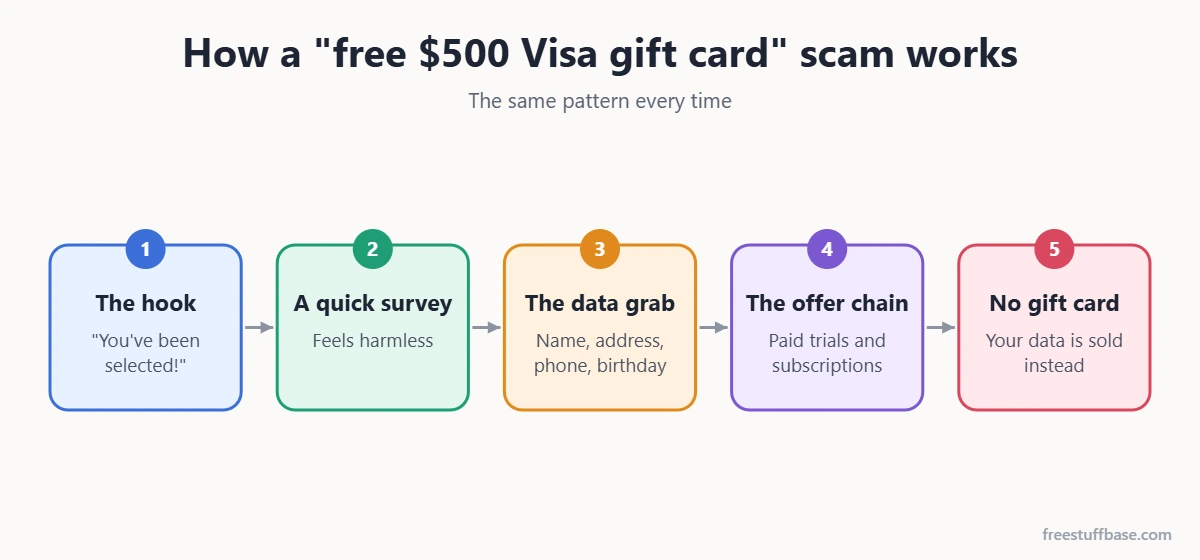
These offers usually follow the same pattern:
- The hook: a text, email, pop-up ad or social post says you’ve won or been selected for a free gift card from a big name like Visa, Walmart, Amazon or Target.
- The “survey”: you answer a few easy questions so it feels legitimate.
- The data grab: you’re asked for your name, address, phone number, email and date of birth to “ship” the card.
- The catch: to claim the prize, you must sign up for multiple “offers” (paid trials, subscriptions, credit applications), pay a small shipping fee, or refer friends.
The gift card never arrives. Instead, your details are sold to marketers, your card is charged for subscriptions, or the information is used for identity theft.
This isn’t new. In 2013 the FTC announced eight lawsuits against 29 defendants accused of sending more than 180 million spam texts promising “free” $1,000 gift cards to stores such as Best Buy, Walmart and Target. According to the FTC, people who followed the links were pushed through a long series of offers and then told they had to get three friends to sign up as well.
Where these offers show up
- Text messages from unknown numbers saying you’ve been “selected”.
- Emails dressed up with retailer or Visa logos.
- Pop-up ads and fake “spin the wheel” pages on otherwise normal websites.
- Social media comments, DMs and sponsored posts.
- Browser notifications you accidentally allowed on a dodgy site.
Wherever it appears, a free $500 Visa gift card offer that asks you to click a link and “claim” it follows the same playbook.
Why scammers use Visa gift cards as bait
A Visa gift card feels like cash: almost everyone can use one, so the prize sounds more useful than a gift card for a single store. Scammers borrow the Visa name and logo because it is trusted, then rely on urgency and excitement to stop people thinking clearly. The bigger the promised amount, the more likely people are to hand over personal details or a card number to “cover shipping”.
Red flags
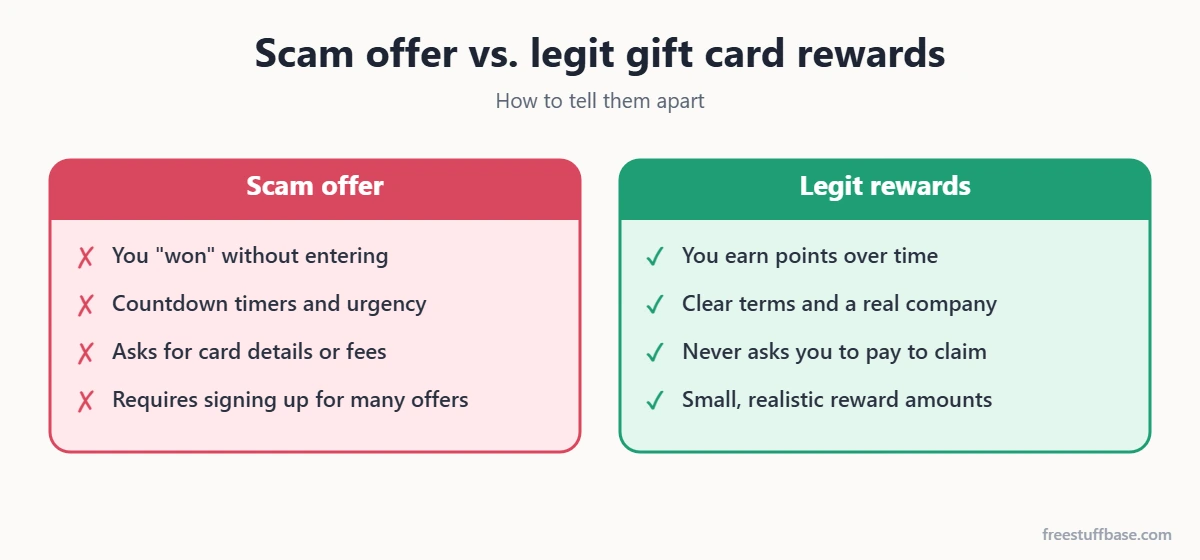
- You “won” something you never entered.
- The message creates urgency: “Claim in 10 minutes!”
- The link goes to a strange or misspelled domain.
- You’re asked to pay anything, even $1.95 for shipping.
- You’re asked for your bank card, Social Security number or account password.
- The “official rules” are missing, vague or hard to find.
What to do if you already clicked
- If you entered card details: call your bank or card issuer, dispute unknown charges and ask about a new card number.
- If you entered passwords: change them, starting with your email.
- If you gave your Social Security number: consider a credit freeze with the three credit bureaus and visit IdentityTheft.gov.
- Report it: forward scam texts to 7726 (SPAM) and report the scam at ReportFraud.ftc.gov.
Can you get a Visa gift card legitimately?
Yes, but you’ll earn it rather than win it out of nowhere:
- Rewards programs: some established programs such as Swagbucks or MyPoints offer prepaid Visa cards or other gift cards as redemption options.
- Credit card and bank rewards: many issuers let you redeem points for gift cards.
- Employer and wellness programs: some employers and health insurers reward healthy activities with gift cards.
- Real sweepstakes: enter only sweepstakes with official rules from a real sponsor. See our guide to which sweepstakes are legitimate.
Be realistic about the numbers. Legitimate rewards and cashback programs usually pay out a few dollars at a time, so earning a $25 or $50 gift card can take weeks or months. That slow pace is a good sign: it means the program is paying for your time or purchases, not promising something too good to be true.
How to protect yourself in the future
- Never click prize links in texts or emails; go to the company’s website yourself instead.
- Turn on your phone’s spam filtering and block numbers that send prize texts.
- Don’t allow notifications from websites you don’t know.
- Use a pop-up blocker and keep your browser updated.
- Talk to older relatives about these scams — they are often targeted.
The FTC explains how to recognize and report spam text messages. If you think your identity was stolen, use IdentityTheft.gov to get a recovery plan.
Common free $500 Visa gift card scam types compared
When we looked at the pages ranking for this search, most of them describe one kind of scam. In reality, the free $500 Visa gift card bait comes in several forms, and each one is after something slightly different. This table helps you recognize which version you are looking at.
| Scam type | How it reaches you | What the scammer wants |
|---|---|---|
| Reward funnel pages | Pop-up ads, sponsored posts, redirect links | Your email, phone number and sign-ups for paid trials or partner “deals” |
| Fake survey texts | Text message saying you won or were selected | Personal details and a click on a phishing link |
| Postcard or mail offers | Glossy postcard asking you to call a number | A small “shipping” or “processing” fee and your card details |
| Hijacked social media giveaways | A friend’s account or a fake brand page | Shares, tags and your login details |
| Browser pop-up “prize” alerts | A full-screen message on a website | Your information, or a download that installs adware |
| Card draining in stores | A tampered card on a store rack | The money you load onto a real gift card |
Reward funnels: why “complete a few deals” never ends
Many free $500 Visa gift card pages are not trying to steal your bank login straight away. They are lead-generation funnels. You enter your email, answer a short quiz and are then told to complete a number of “partner offers” before the card is released. Those offers are subscriptions, loan applications, trial products and apps, and the page owner earns a commission for each one you finish.
The finish line keeps moving. Some offers do not count, some need a purchase, and the number you must complete keeps growing. Meanwhile your phone number and email are sold to marketers, which is why many people start getting spam calls and texts afterwards. If a page asks you to complete deals to unlock a free $500 Visa gift card, close it.
Mail and postcard offers that ask for a small fee
Another version arrives in your mailbox. A colorful postcard says you have a $500 gift card waiting and gives you a number to call. The caller then asks for a small payment for postage or processing, plus your card number. Real prizes do not require you to pay to collect them. Paying even a few dollars hands over your card details, and you will not receive the free $500 Visa gift card.
Card draining: the scam that targets real Visa gift cards
Not every gift card scam starts online. In card draining, criminals take real prepaid cards from store racks, record the numbers, reseal the packaging and put them back. When a shopper buys and loads the card, the thief spends the balance first. It is not a free $500 Visa gift card offer, but it shows why you should be careful with any Visa gift card.
- Buy gift cards kept behind the counter when you can.
- Check that the packaging is not torn, re-glued or loose around the PIN area.
- Keep the receipt until the card is fully spent.
- Register the card on the issuer’s official website if it offers that option, and check the balance soon after buying.
Real $500 Visa gift card giveaways: how they differ from scams
Legitimate prize promotions do exist. Radio stations, banks, credit unions and well-known brands sometimes give away prepaid Visa cards. The difference is that a real giveaway follows clear rules.
| Real giveaway | Free $500 Visa gift card scam |
|---|---|
| Official rules page naming the sponsor and the prize | No rules, or vague text that is hard to find |
| No purchase or fee needed to enter or win | Asks for a fee, card number or bank details |
| Winners chosen by a stated method and date | Everyone who clicks is told they have “won” |
| Contact comes from the sponsor’s real website or verified account | Contact comes from a random number, email or new social media page |
| You entered the contest yourself | You never entered anything |
How to report a free $500 Visa gift card scam
Reporting helps platforms and investigators shut these pages down faster. It only takes a few minutes.
- Report the scam to the Federal Trade Commission at ReportFraud.ftc.gov.
- Forward scam texts to 7726 (SPAM) so your mobile carrier can block the sender.
- Report fake ads and posts directly on Facebook, Instagram, TikTok or wherever you saw them.
- If you shared card or bank details, call your bank right away and ask them to block the card.
- Tell friends and family, especially older relatives, so they recognize the same message.
Safer ways to earn Visa gift cards
If what you really want is extra spending money, there are slow but real ways to get prepaid cards without risking your data. Credit card and bank sign-up bonuses, workplace rewards, legitimate market research panels and well-known rewards apps sometimes pay out in prepaid Visa cards. The amounts are smaller and take time to earn, but the rewards actually arrive. Any offer that promises a free $500 Visa gift card instantly, with no effort, is the one to avoid.
A 60-second check before you trust any Visa gift card offer
You do not need to be a tech expert to spot a fake. Run through these quick questions whenever a free $500 Visa gift card offer appears on your screen, in your inbox or in your mailbox.
- Did I enter a contest? If not, you did not win one.
- Who is the sponsor? A real offer names a real company and links to its official website.
- Is there an official rules page? Legitimate promotions publish eligibility, dates and how winners are picked.
- Am I being asked to pay anything? Fees, shipping charges or card numbers mean it is a scam.
- Is there a countdown timer? Fake urgency is designed to stop you thinking.
- Does the web address look right? Look for misspellings, extra words or odd endings in the URL.
- Would I be happy if this information leaked? If not, do not type it in.
If an offer fails even one of these checks, walk away. It costs nothing to ignore a fake prize, but it can cost a lot to chase one.
What scammers do with the information you give them
People often think that sharing only a name and email is harmless. In practice, the data collected by a free $500 Visa gift card page is valuable to criminals and shady marketers.
- Email address: added to spam and phishing lists, so you receive more fake prize messages.
- Phone number: sold to robocallers or used to send scam texts that look like delivery or bank alerts.
- Home address and date of birth: combined with other leaked data to open accounts in your name.
- Card number and security code: used for unauthorized purchases or small test charges.
- Social media logins: used to take over your account and send the same scam to your friends.
If you have already given away more than an email address, change any passwords you reused, turn on two-factor authentication for important accounts and keep an eye on your bank statements for the next few months. You can also check your credit reports for free at AnnualCreditReport.com to make sure no new accounts have been opened in your name.
FAQ
Is “Visa Gift Card Rewards” a real program?
Visa itself doesn’t run random giveaways through texts or pop-ups. Prepaid Visa gift cards are issued by banks and sold or awarded by other companies. Treat any message using Visa’s name to promise a free card as suspicious.
Why do these ads appear on real websites?
Some ad networks let low-quality advertisers through. A scam ad appearing on a legitimate site doesn’t make it legitimate.
I received a real-looking Visa gift card in the mail. Is it safe?
Unexpected cards can be legitimate (for example rebate cards), but never call a phone number printed on an unexpected card or letter. Look up the issuer’s official contact details yourself.
Can I get a free $500 Visa gift card from a survey?
No. Legitimate survey sites pay small amounts per survey, and it takes a long time to earn a gift card of any size. A single survey that “unlocks” a $500 card is a scam.
I only gave my email address. Should I worry?
You’ll probably see more spam. Mark those emails as spam, don’t click links in them, and change your password if you used it on the scam site.
Does Visa ever give away gift cards?
Visa doesn’t contact random people to hand out prepaid cards. Prepaid Visa cards are issued by banks and sold by retailers, and any genuine promotion will have official rules and a real sponsor you can look up.
Should I warn friends about the free $500 Visa gift card scam?
Yes. These messages often spread through shared links and group chats. A quick warning, or sharing this page, can stop someone you know from handing over their details.
Why do I keep getting free $500 Visa gift card texts?
Your number was likely added to a spam list, often after a data breach or after entering it on a reward page. Do not reply or click. Report the text to 7726 and block the sender.
Is a free $500 Visa gift card offer on Facebook real?
Almost never. Scammers create fake brand pages and use hacked accounts to post these giveaways. Check whether the page is verified, has a long history and links to official rules before you trust it.
What if I paid a fee for a free $500 Visa gift card?
Contact your bank or card issuer immediately, explain that the payment was part of a scam and ask whether it can be disputed. Then report it to the FTC.
Final thoughts
A free $500 Visa gift card that arrives out of nowhere is almost always a scam designed to collect your details or sign you up for paid offers. Don’t click, don’t pay any “shipping” fee and report it at ReportFraud.ftc.gov. If you want real gift cards, earn them slowly through rewards and cashback programs instead. See our guides to the best cashback apps, which sweepstakes are legitimate and the free $100 Amazon gift card scam.

Md. Emam Hasan is the founder of Freestuffbase and a digital marketer and SEO specialist based in Dhaka, Bangladesh. He researches free samples, gift card policies and sweepstakes rules from official sources, and writes practical guides to help readers save money and avoid scams. More at emamit.com.