
Quick answer: The best free online courses in 2026 come from MIT OpenCourseWare, Harvard’s free catalog, Khan Academy, freeCodeCamp and Microsoft Learn, which are free to use in full. edX still lets you audit most courses for free for a limited time. Coursera changed the most: in 2025 it replaced its old audit option with a free preview of the first module of most courses, so full access now usually means paying or applying for financial aid. Your public library card may also unlock LinkedIn Learning for free.
How we put this together: we compared leading free course roundups with each platform’s own help pages and announcements, including Coursera, edX, MIT OpenCourseWare, Harvard, freeCodeCamp, Khan Academy, Microsoft and LinkedIn, and we link our sources. Free access rules change often, so check the course page before you enroll.
“Free” means very different things on different learning sites. Some give you everything, including a certificate. Others let you watch lectures but lock graded work, and some only show you the first module. This guide explains where to find genuinely free online courses, what each one includes, and how to avoid paying for something you could get free.
Table of Contents
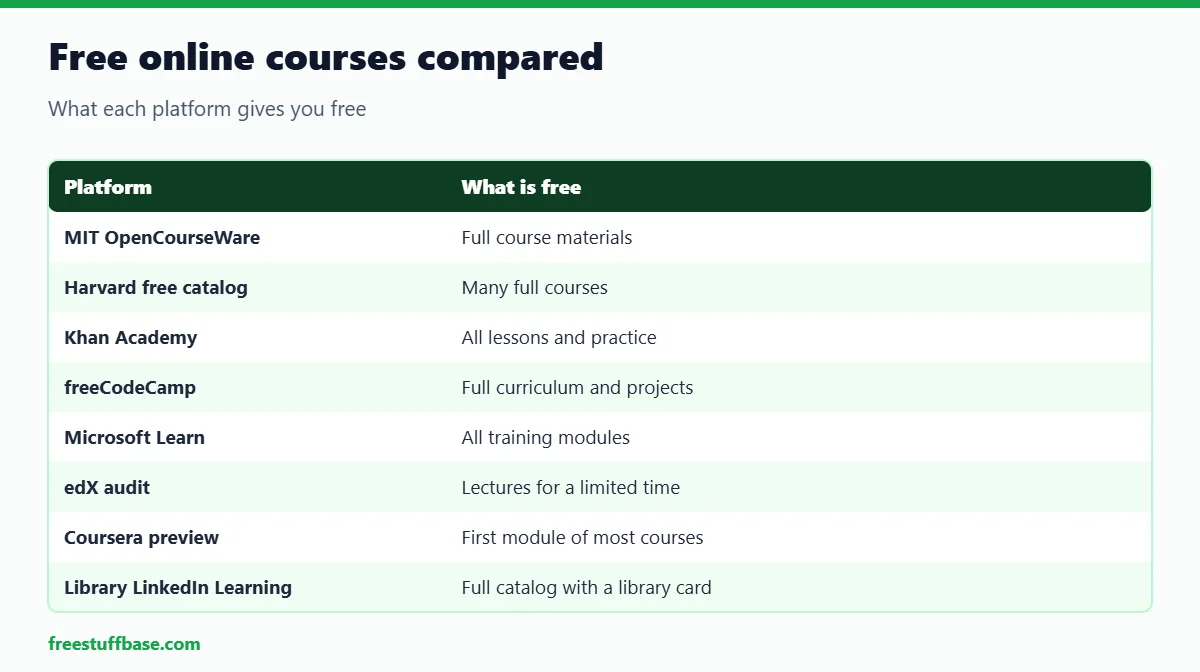
Free online courses compared
| Platform | What is free | Free certificate? |
|---|---|---|
| MIT OpenCourseWare | Full course materials | No |
| Harvard free catalog | Many full courses | Usually paid |
| Khan Academy | All lessons and practice | No |
| freeCodeCamp | Full curriculum and projects | Yes |
| Microsoft Learn | All training modules | Achievements free, exams paid |
| edX audit | Lectures for a limited time | No |
| Coursera preview | First module of most courses | No |
| Library LinkedIn Learning | Full catalog with a library card | Yes |
1. MIT OpenCourseWare
MIT OpenCourseWare is a free and open publication of material from thousands of MIT courses across the entire curriculum. Many courses include full video lectures, free online textbooks, problem sets and exams with solutions. You do not need an account.
The trade-off is support. OCW says it does not offer any degree, credit or certification, and there are no instructors to grade your work. It suits self-motivated learners who want university-level depth in subjects like math, physics, computer science and economics.
2. Harvard’s free courses
Harvard lists many free courses in its Professional and Lifelong Learning catalog, including the famous CS50 introduction to computer science, Justice, data science courses in R and Python, and shorter Harvard Business School Online lessons. Most run through edX, so the edX audit rules below apply, and the asterisk next to “Free” usually means a verified certificate costs extra.
3. Khan Academy
Khan Academy is a nonprofit with a mission of providing a free, world-class education to anyone, anywhere. It covers math from early grades through calculus, science, economics, grammar, history and test prep, with practice exercises that adapt to your level. It works well for adults filling gaps before a college class or helping kids with homework, and there are no ads or paywalls.
4. freeCodeCamp
freeCodeCamp’s about page says every part of the platform is free, including the courses, the projects and the certifications. It is a donor-supported nonprofit that teaches web development, Python, JavaScript and related skills through hands-on projects in your browser. Each certification takes around 300 hours of study, so it is a serious commitment, but it costs nothing.
5. Microsoft Learn and other company training
Microsoft says its Microsoft Learn training is free and available to anyone. You can work through modules and learning paths on Azure, Excel, Power BI, Teams, AI and more, and earn free achievements. Official certification exams still cost money. Other large tech companies also publish free beginner training on their own products, so check the company’s learning site before paying a third party.
6. edX: free audit with time limits
edX’s help center says most courses can be audited free. Audit learners get temporary access to course materials except graded assignments, and do not earn a certificate. Your audit access expires after the estimated course length, so plan to finish on schedule and save notes as you go.
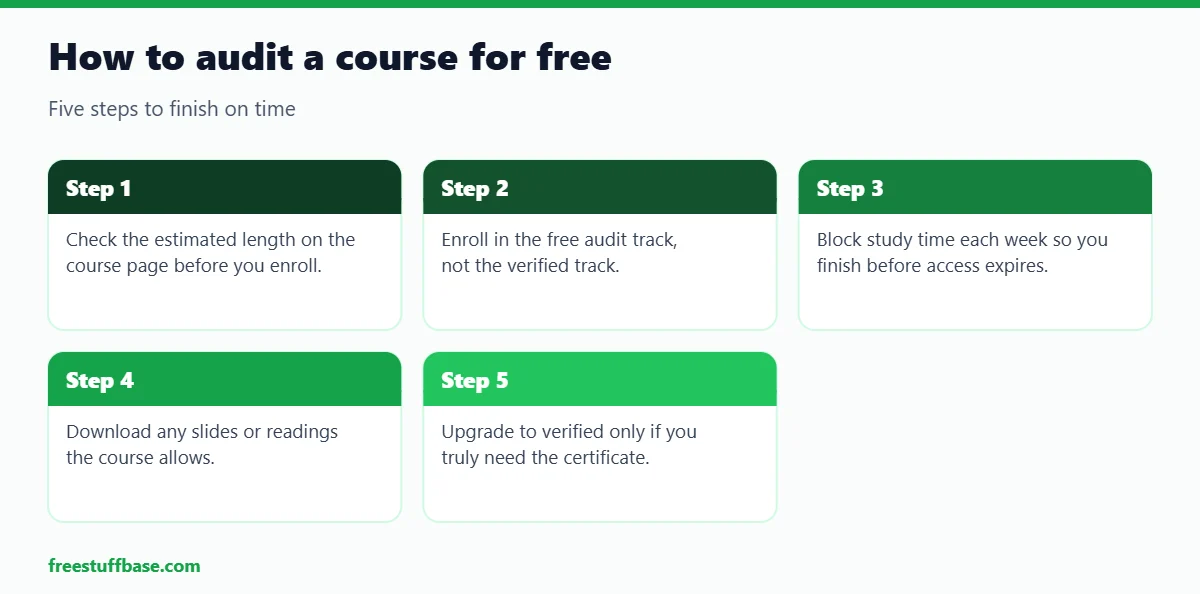
To get the most from an edX audit:
- Check the estimated length on the course page before you enroll.
- Enroll in the free audit track, not the verified track.
- Block study time each week so you finish before access expires.
- Download any slides or readings the course allows.
- Upgrade to verified only if you truly need the certificate.
7. Coursera: what changed
Coursera used to be the easiest place to audit university courses for free. That changed in 2025. In its August 2025 announcement, Coursera said its new preview model replaces the audit experience and lets learners preview the first module of nearly every course for free.
You can still get full Coursera courses without paying in two ways. Some courses are fully free, so check the enrollment options. And Coursera offers financial aid on many courses, applied for course by course through the course page. If you need the certificate for work or a job application, financial aid is worth trying before paying.
8. LinkedIn Learning with your library card
Many public libraries pay for LinkedIn Learning so their members can use it free. LinkedIn’s help page explains that you sign in with your library’s ID, your library card number and PIN. The catalog covers business, software, design, photography and career skills, and completed courses can be added to your profile. If your library does not offer it, ask what other online learning services it has.
Libraries are also good for free ebooks and audiobooks; see our guides to free Kindle books and free audiobooks.
9. Community colleges, workforce programs and YouTube
Local community colleges and state workforce programs sometimes offer free short courses in digital skills, bookkeeping or English. YouTube also hosts full lecture series from universities and long, free coding courses, including many from freeCodeCamp. These have no certificates, but they are useful for learning one specific skill fast.
How to pick the right free online course
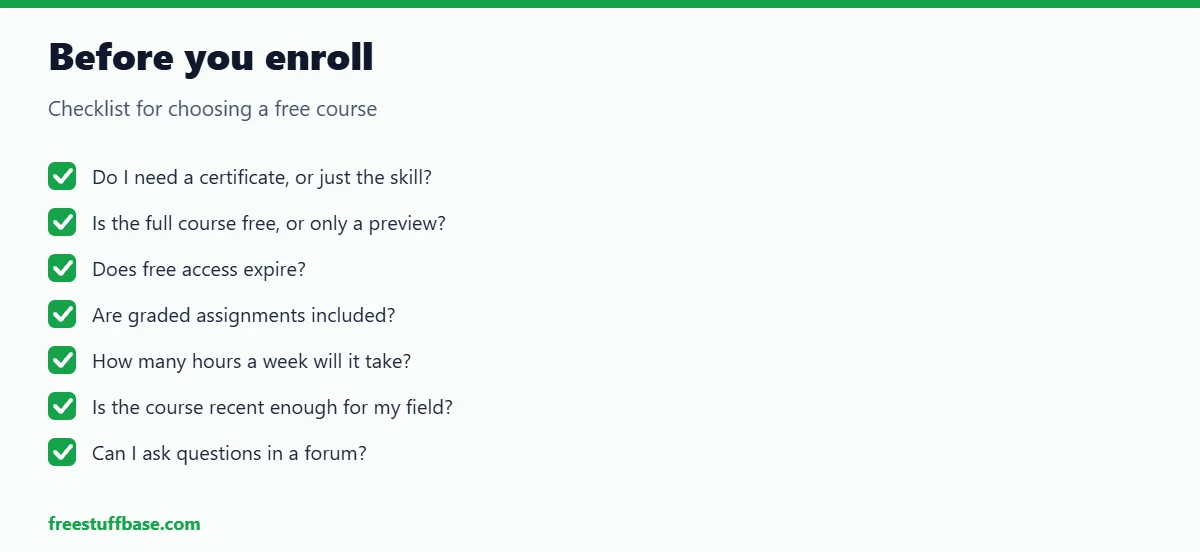
The best free online course is the one you finish. Use this checklist before you enroll:
- Do I need a certificate, or just the skill?
- Is the full course free, or only a preview?
- Does free access expire?
- Are graded assignments included?
- How many hours a week will it take?
- Is the course recent enough for my field?
- Can I ask questions in a forum?
Who benefits most
Students can pair free courses with campus resources; see our list of free stuff for college students. Older adults can learn new tech skills at their own pace, and our guide to free stuff for seniors covers other discounts. If cost of internet access is the barrier, the Lifeline program can lower your monthly phone or internet bill.
Watch out for paid traps
Some sites advertise “free online courses” and then charge for a required exam, or start a subscription after a free trial. Before you sign up, read what happens when a trial ends, set a reminder to cancel, and do not enter a card if the course is supposed to be free.
FAQ
Are free online courses worth it?
Yes, if you choose well. Courses from MIT, Harvard, Khan Academy and freeCodeCamp are high quality. The main limits are certificates and instructor feedback, not the teaching itself.
Can I still audit Coursera courses for free?
In most cases, no. Coursera replaced its audit option with a free preview of the first module of most courses. Some courses are still fully free, and financial aid is available on many paid courses.
Which free online courses give a free certificate?
freeCodeCamp certifications are free, and LinkedIn Learning certificates are free if your library provides access. Microsoft Learn gives free achievements, though official exams cost money.
Do free online courses count for college credit?
Usually not. MIT OpenCourseWare offers no credit, and audit tracks do not include certificates. Some paid programs offer credit, so ask the college that would accept it.
Last checked: November 2026. Free access rules, certificate prices and course catalogs change often, so check each course page for current terms before you enroll.

Md. Emam Hasan is the founder of Freestuffbase and a digital marketer and SEO specialist based in Dhaka, Bangladesh. He researches free samples, gift card policies and sweepstakes rules from official sources, and writes practical guides to help readers save money and avoid scams. More at emamit.com.