

Quick answer: The fastest ways to save money on groceries are to plan meals around what is on sale, shop with a list, compare unit prices instead of package prices, switch to store brands, and stop throwing food away. USDA estimates a family of four loses about $1,500 a year to uneaten food, so cutting waste is often the biggest single saving. Add your store’s loyalty app and a cash back app and the savings stack up without extreme couponing.
How we put this together: we compared top grocery-saving guides with official sources, including USDA’s food price outlook and food plans, USDA and FDA food waste guidance, and university extension advice on unit pricing, and we link our sources. Prices vary by store and region, so test these tips against your own receipts.
Grocery bills are one of the few big expenses you can change every week. USDA’s Economic Research Service expects food-at-home prices to keep rising in 2026, though more slowly than in recent years, and some items like beef are rising faster than average. This guide explains how to save money on groceries with habits that work for any household, not just dedicated couponers.
Table of Contents
How to save money on groceries: the 15 tips at a glance
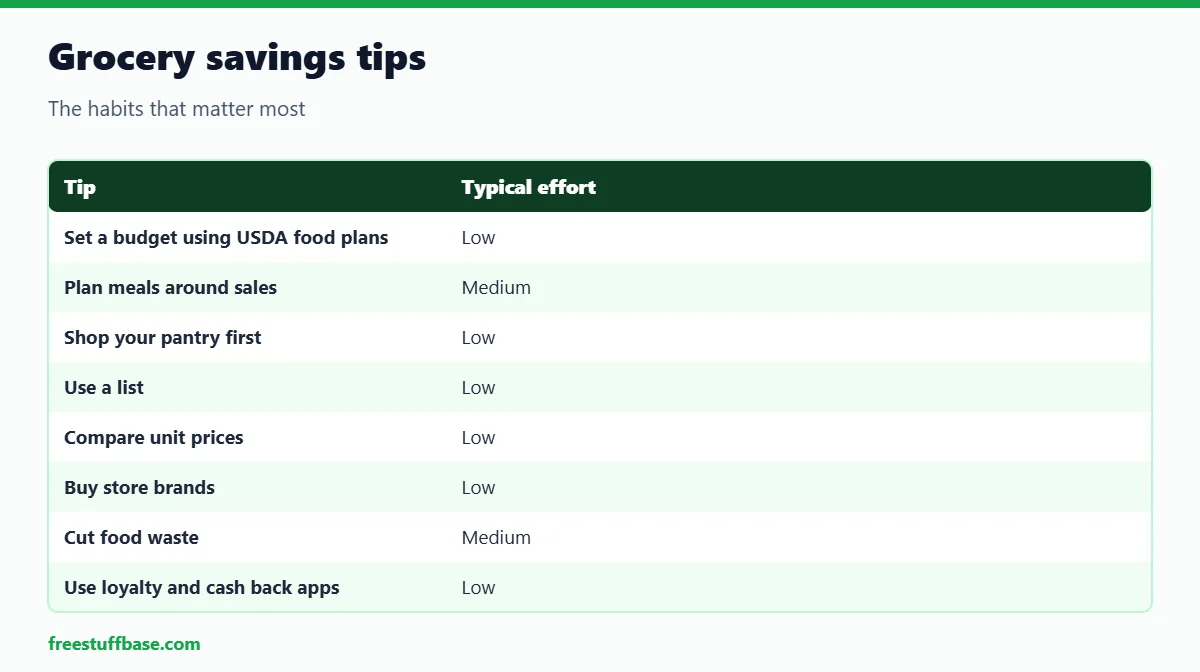
| Tip | Typical effort | Where it saves |
|---|---|---|
| Set a budget using USDA food plans | Low | Whole bill |
| Plan meals around sales | Medium | Main dishes |
| Shop your pantry first | Low | Duplicate buys |
| Use a list | Low | Impulse buys |
| Compare unit prices | Low | Every aisle |
| Buy store brands | Low | Staples |
| Cut food waste | Medium | Whole bill |
| Use loyalty and cash back apps | Low | Every trip |
Plan before you shop
1. Set a realistic budget
Learning how to save money on groceries starts with a number. USDA publishes monthly food plans at four cost levels: thrifty, low-cost, moderate-cost and liberal. In its June 2026 report, the thrifty plan for a family of four with two school-age children came to about $236 a week, or $1,023 a month. Compare your actual spending with these levels to see where you stand.
2. Plan meals around what is on sale
Check your store’s weekly ad or app before you plan. Build two or three dinners around discounted proteins and produce, then fill in with pantry staples. Planning first and shopping second is the habit that makes every other tip work.
3. Shop your pantry, fridge and freezer first
Before writing a list, look at what you already have and build at least one meal from it. This prevents duplicate purchases and uses food before it spoils.
4. Make a list and stick to it
Impulse buys add up quickly. Write your list by store section, shop after eating, and leave the kids at home if you can. Online ordering with pickup can also help, because you see your total before you check out.
Shop smarter in the store
5. Compare unit prices, not package prices
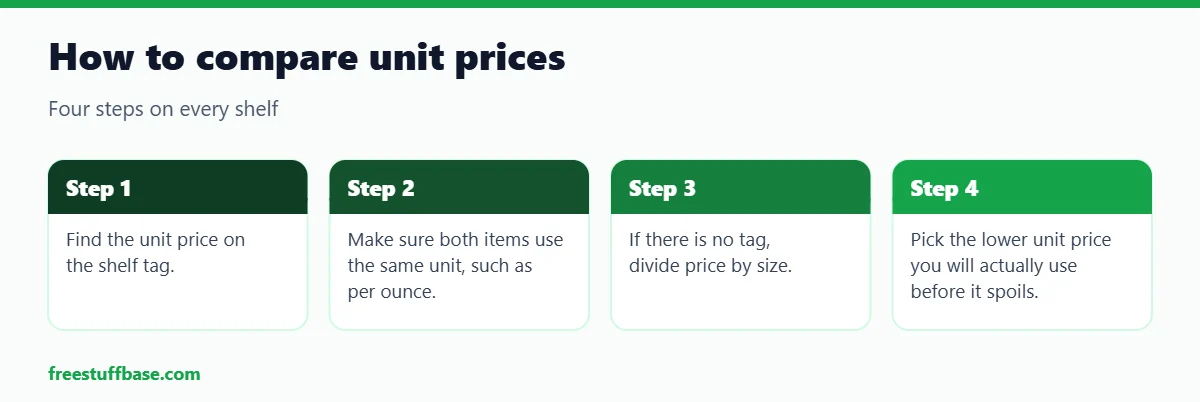
The unit price shows the cost per ounce, pound or count. NDSU Extension explains that the shelf tag usually shows both the total price and the price per unit, and that you can work it out yourself by dividing the item price by the item size. Bigger packages are often cheaper per unit, but not always, so check.
- Find the unit price on the shelf tag.
- Make sure both items use the same unit, such as per ounce.
- If there is no tag, divide price by size.
- Pick the lower unit price you will actually use before it spoils.
6. Choose store brands
Switching brands is one of the easiest ways to save money on groceries. Store-brand staples like flour, sugar, canned beans, frozen vegetables, milk and cleaning supplies are usually cheaper than name brands. Try one store-brand swap a week and keep the ones your family does not notice.
7. Buy produce in season, and use frozen
Seasonal fruit and vegetables are cheaper and taste better. Frozen produce is a good value for items you use slowly, because it lasts for months and cuts waste.
8. Buy whole and do the prep yourself
Pre-cut fruit, shredded cheese and boneless cuts cost more per pound. A whole chicken or block of cheese is usually cheaper than the prepared version, and it only takes a few minutes to cut yourself.
9. Stock up only on true sale prices
Track the prices of the 10 to 15 items you buy most. When one hits its low price, buy enough to last until the next sale, as long as you have room and will use it in time.
10. Try a cheaper store for staples
Discount grocers and warehouse clubs can be much cheaper for some items. A warehouse membership only pays off if you save more than the annual fee, so add it up before you join.
Cut waste at home
11. Store food properly and eat leftovers
If you want to save money on groceries without changing what you eat, start with waste. USDA’s food waste page estimates that 30 to 40 percent of the US food supply is wasted. USDA also says about $1,500 of food goes uneaten each year for a family of four. Plan a leftovers night, freeze extras, and use the free FoodKeeper app to check how long foods last.
12. Understand date labels
The FDA estimates that confusion over date labels accounts for about 20 percent of consumer food waste. “Best by” dates usually describe quality, not safety, so many foods are still fine after that date. When in doubt, check FoodKeeper guidance.
Use apps, coupons and benefits
13. Join your store’s loyalty program
Most grocery chains now give their best prices and digital coupons through their app. Clip offers before you shop and scan your account at checkout. Our guide to couponing for beginners shows how to combine store and manufacturer coupons.
14. Add a cash back app
Receipt and cash back apps give small rewards on things you already buy. See our best cashback apps list, plus our Ibotta review and Fetch Rewards review, to choose one or two that suit how you shop.
15. Check if you qualify for food benefits
If money is tight, SNAP and WIC can help a lot. Many food banks and pantries also offer free groceries with no long application. Free samples can cover a few extras too; see our guide to free coffee samples.
A simple weekly routine
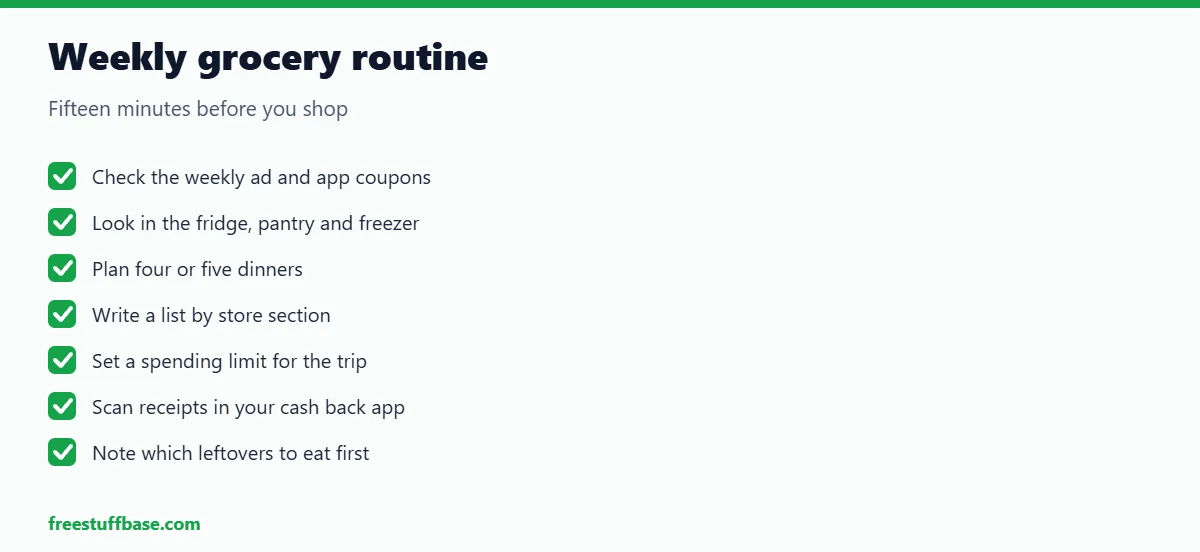
This routine is how to save money on groceries week after week without much effort. Try it for a month:
- Check the weekly ad and app coupons
- Look in the fridge, pantry and freezer
- Plan four or five dinners
- Write a list by store section
- Set a spending limit for the trip
- Scan receipts in your cash back app
- Note which leftovers to eat first
Common mistakes to avoid
- Buying in bulk without the space or time to use it.
- Shopping hungry or without a list.
- Assuming the biggest package is always cheapest.
- Buying “deals” on items you would not normally buy.
- Paying for multiple grocery delivery memberships you rarely use.
FAQ
What is the fastest way to save money on groceries?
The quickest answer to how to save money on groceries is to make a meal plan based on sales, shop with a list, and cut food waste. These three habits usually save more than coupons alone.
How much should a family spend on groceries?
USDA’s food plans give a guide. In June 2026, the thrifty plan for a family of four with two school-age children was about $1,023 a month. Your number depends on where you live and how often you cook.
Are store brands really as good?
For many staples they are similar, and they usually cost less. Try one swap at a time and keep the ones you like.
Do grocery apps actually save money?
Yes, if you use them for things you already buy. Clipping store app coupons and scanning receipts takes a few minutes per trip.
Last checked: November 2026. Grocery prices, store programs and app offers change often, so check current prices and terms where you shop.

Md. Emam Hasan is the founder of Freestuffbase and a digital marketer and SEO specialist based in Dhaka, Bangladesh. He researches free samples, gift card policies and sweepstakes rules from official sources, and writes practical guides to help readers save money and avoid scams. More at emamit.com.